
Olympic gold

Stories and Legends
The Queen of the Dolomites welcomes — and still embraces — stories of every kind.
The Dolomites hold a millennia-old heritage of legends, surrounding Cortina d’Ampezzo with an atmosphere of mystery and fascination.
The legends of Cortina are deeply intertwined with its history. Every ridge, every mountain, every corner of the valley has a story to tell, conveying a sense of wonder and respect for nature and for the ancient traditions that shape the soul of Cortina d’Ampezzo.
These tales explain remarkable natural phenomena such as the Enrosadira, the pink glow that colors the Dolomites at sunrise and sunset, as well as the pale, moon-like rock of the Monti Pallidi and the delicate strength of the edelweiss. They tell of ancient peoples, priestesses of water and sun, forgotten kingdoms, heroes, and tragic love stories — legends that gave rise to curses said to endure even today.
Within these captivating stories also emerge real historical figures, whose deeds became legendary over time. From the Knight of Brac to the “Flying Red”, from the Castle of Podestagno (Botestagno) to the Winter Olympic Games, history and myth blend into a unique narrative.
Welcome to the mythology — in its own way, almost Olympic — of Cortina d’Ampezzo, Queen of the Dolomites.
In the valleys and on the peaks of the Dolomites, the legends of Cortina d’Ampezzo tell of heroes who challenged the elements, fairies who wove destinies, and ancient spirits watching over the mountains.
Every echo among the rocks and every whisper of the wind carries the memory of centuries-old stories, wrapping the landscape in an atmosphere of timeless charm and mystery.
Cortina and the Dolomites are rich in legends and ancient stories.
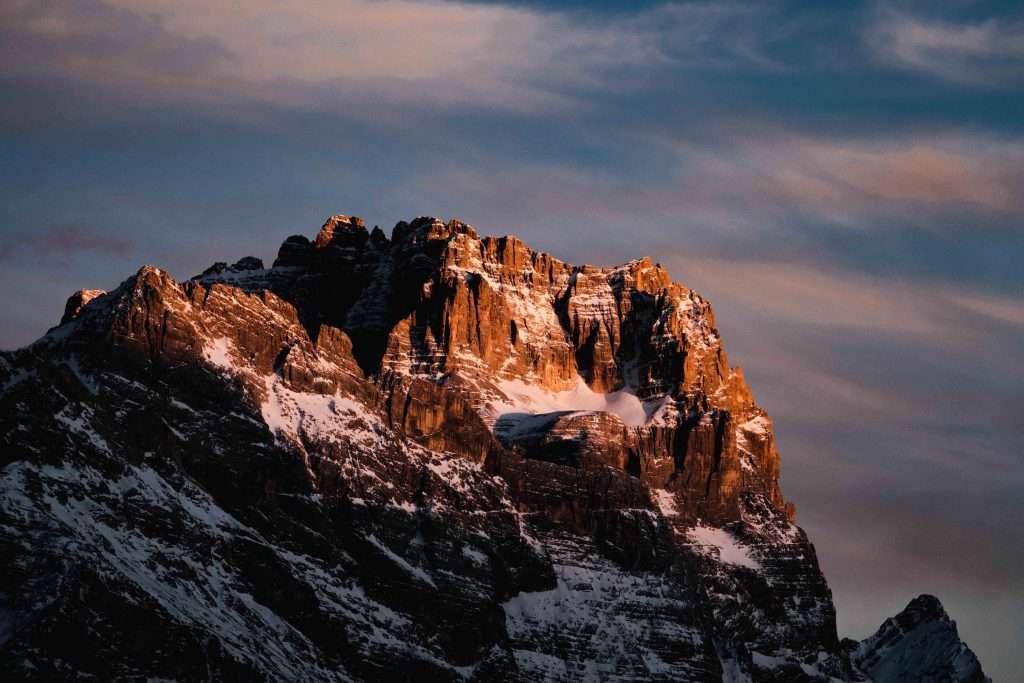
Some are related to natural phenomena such as the Enrosadira, which dyes the snow-white rock of the Dolomites pink and orange. It is inspired by the legend of King Laurin who, jealous of his wonderful rose garden, hid its beauty during day and night, but forgot two moments: sunrise and sunset.
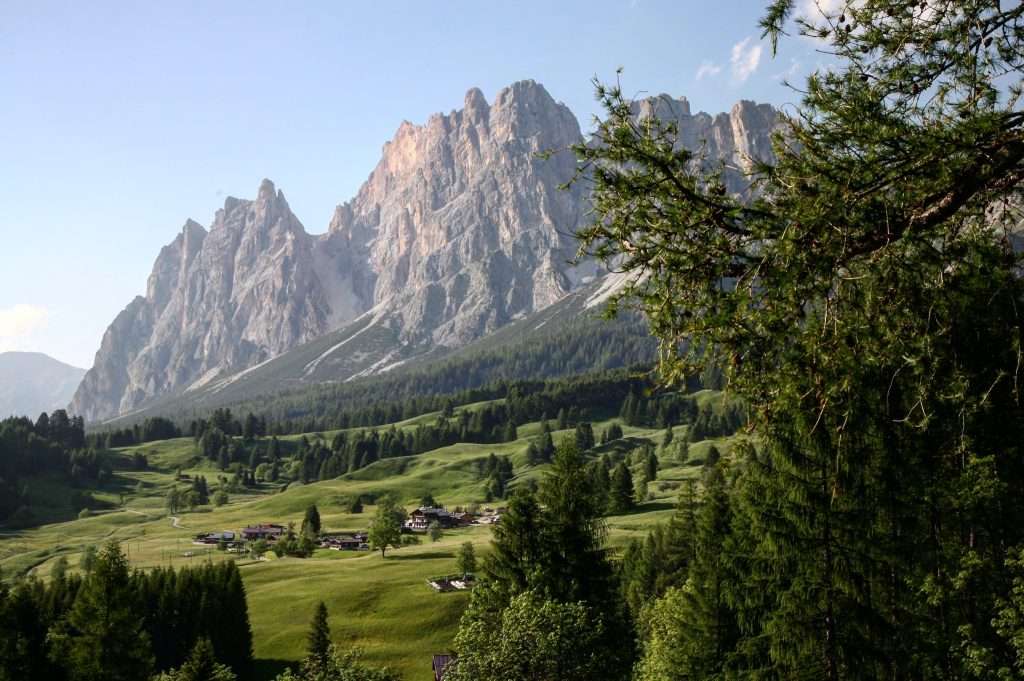
Others speak of the color of Dolomia rock, which earned these peaks the name Pale Mountains. The princess of the Moon, fell in love with a young prince and moving to Earth, she missed the whiteness of her Moon. So the prince had the mountain gnomes weave a large blanket of moonlight to cover the Dolomites, giving it the pale color we still admire today and making the princess happy.
Another legend tells of the edelweiss, believed to be stars gathered by angels and scattered across the mountains. The Dolomites, proud of these delicate flowers, covered their petals with a soft, protective layer to shield them from the cold.
Other tales recount mythical peoples and ancient heroes, as in the Saga of the Fanes, one of the most famous legends of the Dolomites. It even explains the origin of the name Falzarego Pass, linked to the tragic love story of Ey de Net and Dolasilla, and the betrayal by her father, the “false king” — falza-rego.
There are also the Salvàns, the mysterious people of the forests, and the Anguàne, originally priestesses connected to ancient animistic worship of water, sun, and mountains.
And finally, there are stories where the line between myth and history becomes blurred — such as the tale of the Knight of Brach from Marebbe, a real historical figure whose life gradually took on the colors of legend.
The Gran Bracun, or Knight of Brach, is linked to a real historical figure: Franz Wilhelm Prack von Asch, captain of Andraz Castle, who lived in the Ciastel de Brach in Pieve di Marebbe during the 16th century.
Renowned for his skill in battle, he entered legend after reportedly slaying the dragon of Sasso Croce. Another famous tale recounts his daring leap across the 80-meter gorge of Ponte Alto in Cortina d’Ampezzo, riding his horse. The bridge had been sabotaged by enemies who had learned of his journey toward Podestagno Castle, where his beloved Sidonia di Winkelhofen lived.
Although the Knight of Brach managed to escape this dangerous ambush, he did not survive a later assassination plotted by the lords of Colz in 1582. Yet his story endured through oral tradition and artistic depictions, including one that can still be seen today near Ponte Alto in Cortina — a lasting symbol of the thin line between history and legend in the Dolomites.
The King of Fanes was driven by an insatiable thirst for power and wealth — a desire that ultimately led to the downfall of his family and his entire kingdom.
His daughter Dolasilla was a legendary warrior, considered invincible thanks to her white armor, forged by mountain dwarves in gratitude for her honesty and courage. Ey de Net, a hero fighting for the opposing side, fell deeply in love with Dolasilla and asked the King of Fanes for her hand in marriage.
The king, aware of a prophecy that foretold Dolasilla would lose her powers once married, rejected Ey de Net and instead betrayed his own kingdom, secretly striking a deal with the enemy.
Urged by the people of Fanes, Dolasilla entered battle. But without the protection of her armor — now turned black — and stripped of her powers, she was killed in combat.
The King of Fanes, waiting for his reward near Lagazuoi, received only the news of his daughter’s death. As punishment for his betrayal, he was turned to stone, becoming the Falzarego Pass, whose name is said to derive from “falza rego” — the false king.
Olympic gold
A life shaped by sport and ice, among the Dolomites of Cortina d’Ampezzo: Stefania Constantini made history at the Beijing Winter Olympics, winning Italy’s first-ever Olympic gold medal in curling, together with Amos Mosaner. A dream turned into reality, crowned with the most prestigious achievement at the XXIV Winter Olympic Games in 2022.
Their extraordinary chemistry on the ice continued in the years that followed. At the Milano–Cortina Winter Olympics, Stefania Constantini and Amos Mosaner once again stood on the podium, winning the bronze medal and confirming the strength of a partnership that has left a lasting mark on Italian curling.
A modern fairy tale that became part of Cortina’s sporting history — in a discipline whose first Italian clubs were founded in 1954, right here among the peaks of the Queen of the Dolomites.
The Rosso Volante
Winner of six Olympic medals and nine gold medals at the World Championships — including seven in the two-man bobsleigh — he is among the most decorated athletes in history.
Son of Ugo Monti from Auronzo di Cadore and Adele Fabrizi, born in Carnia, he moved to Cortina d’Ampezzo at a young age. Journalist Gianni Brera coined the nickname “Rosso Volante” for him, referring to his fierce competitiveness and the color of his hair.
An Italian bobsledder who has a bobsled track in Cortina d’Ampezzo named after him, he also made history as the first athlete to receive the Pierre de Coubertin Medal at the 1964 Innsbruck Olympics. He gave a bolt from his own bobsled to the British team, which then went on to win the competition, while his own team secured the bronze medal. To the press that criticized him, he responded, “Nash didn’t win because I gave him the bolt. He won because he was faster.”
A champion to be proud of.
The Ghedo
A downhill and Super-G specialist, winner of three World Championship medals and 13 World Cup races, Kristian Ghedina — known in Cortina simply as “Ghedo” — became a legend in 2004.
That year, he performed an extraordinary and unforgettable feat, never seen before on a ski slope: the famous mid-air split over the final jump of the Streif in Kitzbühel, at 137 km/h.
An iconic moment that entered ski racing history — and cemented the legacy of a true champion from Cortina d’Ampezzo.
Today, you can experience something truly unique on the slopes of Cortina: ski alongside Kristian Ghedina, sharing a day on the snow surrounded by the spectacular scenery of the Dolomites. A special opportunity to discover the secrets of downhill skiing and experience the mountains together with one of Italy’s greatest ski champions.
Discover the experience and book your ski day with Kristian Ghedina.
Want to book your experience in Cortina?
Cortina d'Ampezzo
Immerse yourself in centuries-old traditions, be captivated by the legends that echo through the valleys, and admire the natural wonders of the Dolomites. Let yourself be carried away by the unique atmosphere of this alpine paradise.
Become part of the magic of Cortina. Sign up for our newsletter today!
The adventure don’t end here. Do you follow us?
Become part of the magic of Cortina. Sign up for our newsletter today!
The adventure don’t end here. Do you follow us?